

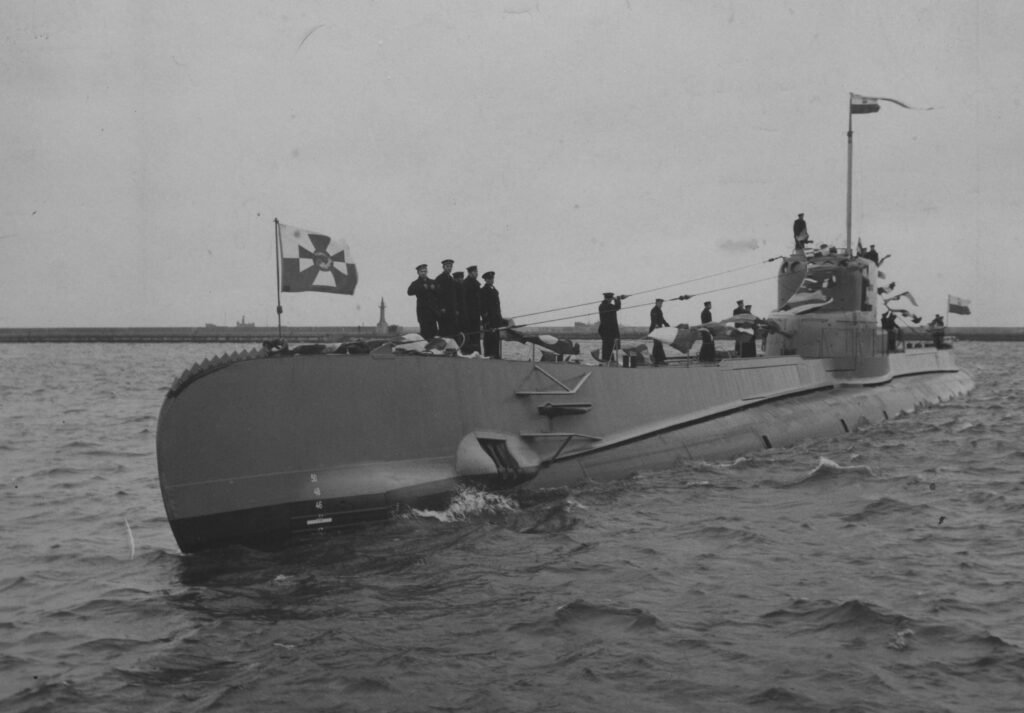
The story of the Polish submarine “Orzeł,” the eagle that saw the catastrophe coming
Lillesand, Norway — April 8, 1940.
The sea off southern Norway is calm. Norwegian fishermen and sailors go about their daily routines. War has already engulfed much of Europe, but Norway remains neutral. In less than 24 hours, everything will change.
Somewhere offshore, hidden beneath the surface, is a submarine. Its name is ORP “Orzeł” — “Eagle” in Polish. Its crew does not yet know it, but that day they are about to become part of the history of both Norway and Poland.
What the sailors discover will provide one of the clearest warnings yet that German forces are preparing to move against Norway. But the warning will not be properly understood in time.
The escape that made “Orzeł” a legend
The story of “Orzeł” does not begin off the Norwegian coast. It begins with the catastrophe that befell Poland in the autumn of 1939.
When Germany invaded Poland on Sept. 1, “Orzeł” was one of the most modern submarines in the Polish Navy. After evading superior German forces, the crew eventually made for the port of Tallinn, Estonia.
There, the submarine’s story nearly came to an end.
Although Estonia was neutral, its authorities decided to intern the submarine. “Orzeł” was disarmed, its navigation charts were confiscated, and its crew was effectively deprived of its freedom.
The Poles had other plans.
On the night of Sept. 17-18, the sailors overpowered the guards, slipped their moorings and escaped into the Baltic despite fire from Estonian forces.
But they had been stripped of their charts and navigational equipment. Ahead of them lay the Baltic Sea. Behind them were German, Estonian and Soviet forces.
They navigated largely from memory, relying on their knowledge of the coastline, a book describing lighthouses and their own seamanship. After several weeks, they reached Britain.
In Poland, the escape of “Orzeł” was hailed as a near-miracle. The submarine became a symbol of a country that had been invaded but had not surrendered.
A mysterious ship off Lillesand
By the spring of 1940, the Polish submarine was operating in the North Sea under British command.
On the morning of April 8, the crew spotted a large ship near Lillesand. It was not flying a flag. The commander of “Orzeł,” Capt. Jan Grudziński, ordered the vessel to stop.
Instead, the ship increased speed.
“Orzeł” fired warning shots. The name on the hull could now be made out: “Rio de Janeiro.”
Why was the ship trying to escape? And why did its crew send an emergency signal after the Polish submarine ordered it to stop and submit to inspection?
The answers would soon emerge from the sea.
The shock awaiting the Norwegian rescuers
After further warnings, “Orzeł” fired its torpedoes. The first two missed. The third struck “Rio de Janeiro,” sending the German transport to the bottom.
Local fishing boats and rescue vessels rushed to the scene to help the survivors. What the rescuers found was startling.
The men in the water were not civilian passengers.
They were German soldiers.
Helmets, weapons, ammunition and military equipment floated around them. And among the survivors, a crucial piece of information quickly emerged:
They were headed for Norway — as part of a German invasion.
This was no ordinary maritime accident. It was direct evidence that German troops and military equipment were already on their way to Norway.
The warning that was not understood
After the war, the same question would be asked repeatedly: How could Norway receive such a clear warning and still fail to grasp what was happening?
The German survivors revealed where they were headed. Norwegian authorities received reports that German soldiers and military equipment had been found aboard the sunken ship. Yet a full mobilization was not ordered.
Only hours later, in the early morning of April 9, 1940, Germany launched Operation Weserübung.
Norway was invaded.
The sinking of “Rio de Janeiro” thus became one of the most dramatic warnings in the hours before the German assault. The Polish submarine had exposed evidence of German preparations for an invasion before the invasion itself began.
But the warning was not correctly interpreted in time.
A Polish act of war, a Norwegian national tragedy
For Poland, the sinking meant more than a successful military operation.
The country was already under occupation. Millions of people were living under German rule and terror. Yet Polish forces continued to fight — at sea, in the air and from bases scattered across Europe.
When “Orzeł” sank “Rio de Janeiro,” it was a reminder that Poland was still in the war.
For Norwegians, the episode came to symbolize something very different: a missed opportunity to understand what was about to happen.
The story of “Orzeł” therefore connects the histories of the two countries in an extraordinary way. Polish sailors were fighting a German operation that was about to change Norway forever.
The mystery that remains unsolved
The most mysterious chapter in the story of “Orzeł” was still to come.
On May 23, 1940, just weeks after the sinking of “Rio de Janeiro,” the submarine left its British base for another patrol.
It never returned.
“Orzeł” disappeared on June 8. No distress signal was received. No survivors were found. The entire crew was lost.
More than 80 years later, the precise circumstances remain unknown.
The submarine may have struck a mine. It may have been accidentally attacked by Allied forces. A technical failure is another possibility.
The wreck of ORP “Orzeł” has still not been found.
A story that refuses to disappear
In Lillesand, a monument in front of the town hall commemorates the Polish submarine and the events of April 1940. The story remains part of the town’s wartime memory.
For Poles, “Orzeł” is a national legend. For Norwegians, it is a reminder of the dramatic hours before April 9, 1940 — the day Norway was drawn into the Second World War.
The story has all the elements of a wartime drama: courage, a daring escape, a secret mission, a looming invasion and a mystery that has never been solved.
Perhaps that is why ORP “Orzeł” still fascinates.
Because in the tense hours before Norway was plunged into war, a Polish submarine was among the first to see the danger approaching.
It sent a warning.
History moved faster than those who were supposed to hear it.