

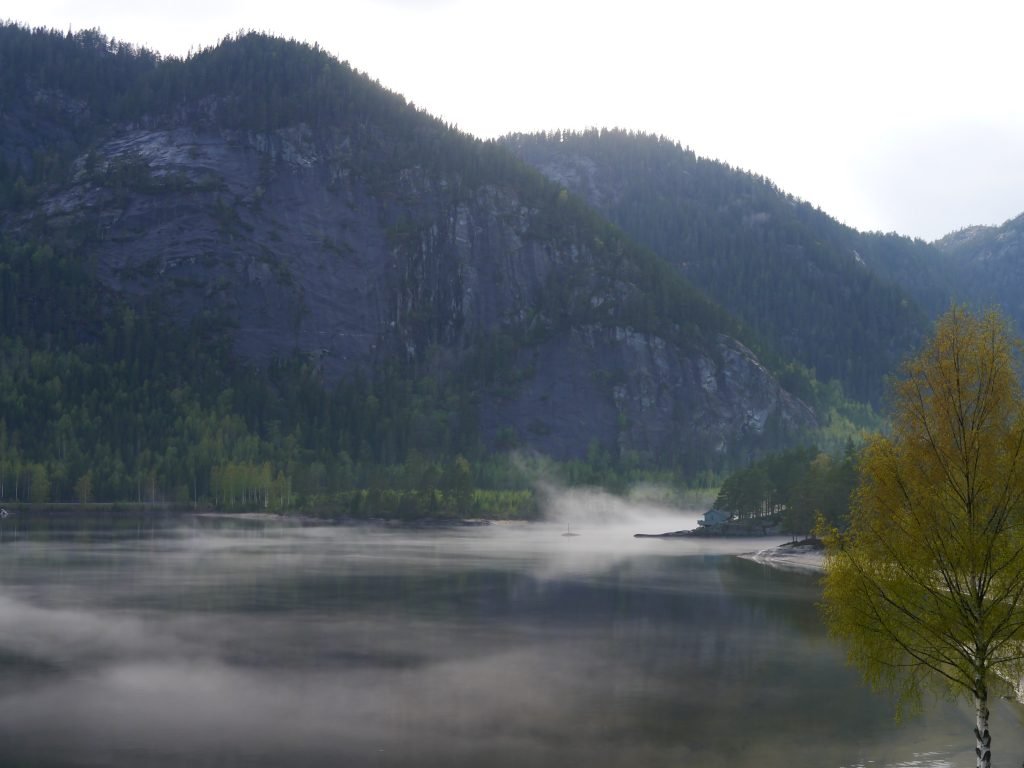
Even at the parking lot in the port of Hirtshals in Denmark, a sign advertising the charms of Setesdal was erected. It’s no wonder. Setesdal is one of the most beautiful parts of Norway and a must-see. It’s a long valley that forms the border between the historic counties ( fylke ) of Øst-Agder and Vest-Agder in southern Norway. It runs through several municipalities ( kommune ).
The Otra River, which carves the valley floor and flows its entire length, emerges from a glacier south of the Hardangervidda plateau in Vestland. It then plunges headlong from a furnace into a lake near the town of Vennesla. There, its flow is slowed by a dam. Below the dam, until its mouth in Kristiansand, the river becomes more serious, flowing only swiftly but steadily.
The valley is approximately 180 km long. The river flows as it pleases: sometimes like a mighty river, and sometimes with a roar it breaks through rocky cliffs, spraying geysers of water and foam. In such places, rafting trips are organized. If the passengers are teenagers, their squeals can drown out the roar of the water. The rafting crew can only number up to ten people.
Along the way, the Otra creates chains of mountain lakes, apparently very deep.
Up the valley, you drive along a road proudly labeled an international road, but in reality, it resembles the old Dobieszczyn-Karsno road, only much more winding, slightly wider, and without potholes. We didn’t encounter any trucks, although they supposedly drive this way, probably bending like snakes. The road is very undulating, with sections requiring shredding in low gears, soon followed by prolonged engine braking. It’s impossible to get lost here, as the steep granite walls, several hundred meters high, prevent any sideways movements. There’s not even a perpendicular road. If there was one in the upper reaches of the valley, it was masked by snow. The road was black and dry, the landscapes were dreamlike, with the occasional glimpse of tall waterfalls tumbling from the cliffs.
All the while, the road gently climbs upwards, only to plunge suicidal around the next bend between jutting rocks. Fortunately, it wasn’t as bad as I expected; at the last moment, the car landed softly on a rocky ledge overhanging the water. At one point, the road was blocked by a rock wall roughly a hundred meters high, plunging vertically into the lake. Long ago, a long gallery had been carved into it to allow for bypassing the obstacle.
The crossing and passage involved the risk of collision with boulders breaking off from the ceiling above the gallery. During the last few years of the road’s operation, dozens of tons of gneiss and granite fell. Previous rainfall was likely continuously removed into the lake. A few years ago, the safety issue was solved by carving a tunnel under the rock mass, using a taut bowstring. The old road was cut off by a high fence adorned with Forbudt signs … The road plunges into a new tunnel carved beneath the rock.
In the tiny village of Bygland, an open-air museum of wooden architecture has been established . The buildings are 200-400 years old. The oddly shaped ground floors of the houses were intended to prevent wolverines from robbing supplies. Norwegians display a strange respect for these small predatory mammals. During military maneuvers, a wolverine is said to have dispersed two army companies and the staff of a field hospital.
Quite unexpectedly, we stopped at a large parking lot in the forest. A few dozen meters below, amidst old spruces festooned with bearded lilies, we saw a magnificent view: at the bottom of the valley, which was slightly wider at this point, stretched a flat, smooth granite slab.
Next to it, the currents of two rivers have carved out channels filled to the gills with raging water. The channels intersect and separate, and each river continues its own path. Only below do they join. This flat terrain attracts tourists who use the massive stone tables and benches set up. Apparently, it’s a popular spot in the summer. Children also enjoy it, as they can safely splash in the warmer water that fills the holes in the rock. There are quite a few such holes in the rock. Judging by the edges polished by their bottoms, they are very popular. No wonder, you can soak in the warm water and admire the panorama of the snow-capped peaks.
Everything ages, including mountains – even those made of resistant granite – which will be obliterated within millions of years. Tectonic movements of the lithospheric plates will raise mountain ranges in other places. This is still ahead of us; for now, water, ice, snow, and temperature changes are eroding rocks. Even vegetation contributes to this, as can be seen on one of the slopes. A snow avalanche toppled several hectares of spruce forest, leaving trees hanging root-first on the slope. Thousands of tons of rock debris flew down. It’s noticeable that seemingly delicate roots can detach even large blocks from solid rock. In the past, before gunpowder was used, quarry workers would hammer pieces of dry wood into the cracks. The wood, poured liberally with water, expanded, widening the cracks and causing large blocks to break.
The mountains surrounding Setesdal are truly strange. Huge, crested rocks of bare granite, covered with spruce at their base, and with meagre birch trees above, and even higher still, so steep and smooth that vegetation has no chance of clinging. The rock walls and floor form a typical U-shaped glacial valley, rising slowly to the edge of the „glacial cirque.” Here, the mountains spread apart, and the floor collapses into a vast basin. The landscape is truly lunar. Rugged, sharp boulders, stones, and elements that are not cosmic, but rather strange: mosses, lichens, peat moss, and rickety sticks that, in better conditions, wouldn’t even be called meagre trees. There’s plenty of snow, though lower down it’s full spring. A glacier peeks out from one of the side valleys. Perched on the northern slope of the cirque is the small town of Hovden, a local ski resort. After another long climb, we reach a pass. The view is strange; the mountains here are flat, sparsely covered with flat birch trees. The trees are 2.5-3 meters tall, and the crowns are cleanly cut, as if by a lawnmower. I speculate that skiers are cutting down the peaks sticking out of the snow. According to my traveling companion, it’s the snowcats that maintain and mow this grove. The shoulders of the road are marked by two rows of poles resembling 4-5-meter lampposts, only instead of lights, they have red and green signs attached. A sort of fairway for snowplows.
Beyond the pass, the road, which winds northward, has an average gradient of 16%. In some sections, it’s only 5-6%, while in others, the steepness is breathtaking. I was a bit nervous, especially when I noticed numerous cracks and gaps in the protective railing above the precipice, and the driver heated things up by saying something about brake problems. A little further north, the road slopes as much as 25% in sections. Drivers often can’t handle the descent and hire a special company to transport their cars with tow trucks.
Luckily, we avoided the dubious pleasure of using a tow truck, and once we finally reached the valley on the other side of the pass, we continued on towards Oslo. But that’s a whole other story.