

Have you ever gone on a spontaneous weekend trip? Panic-packing your backpack with
everything that seems essential because you need to be at the station in an hour?
It usually ends with constantly realizing what you forgot. If you’re heading to a civilized
area—and you haven’t forgotten your wallet—most missing items can be replaced. It’s worse
if you’re going into deep forest or wilderness, where there are no shops and sometimes no
mobile signal.
You can manage without many things, and some can be replaced with what you find in
nature. But before you walk out the door, take five seconds to think about what you’ll wear
on the trip, what you’ll eat, and under what conditions you’ll sleep. Are you sure everything
essential is in your backpack?
Boots
Poorly chosen boots can ruin even the most beautiful trail.
First of all, never take brand-new boots straight from the store onto the trail. It’s better to
wear them around the city first, where any issues are easier to deal with.
Second, try to anticipate the conditions on your route and lean toward a more pessimistic
scenario.
In Norway, at some point during a hike you’ll likely encounter boggy ground in a depression,
a hidden stream in tall grass, or steep rock slabs that require climbing a few meters using
cracks or edges.
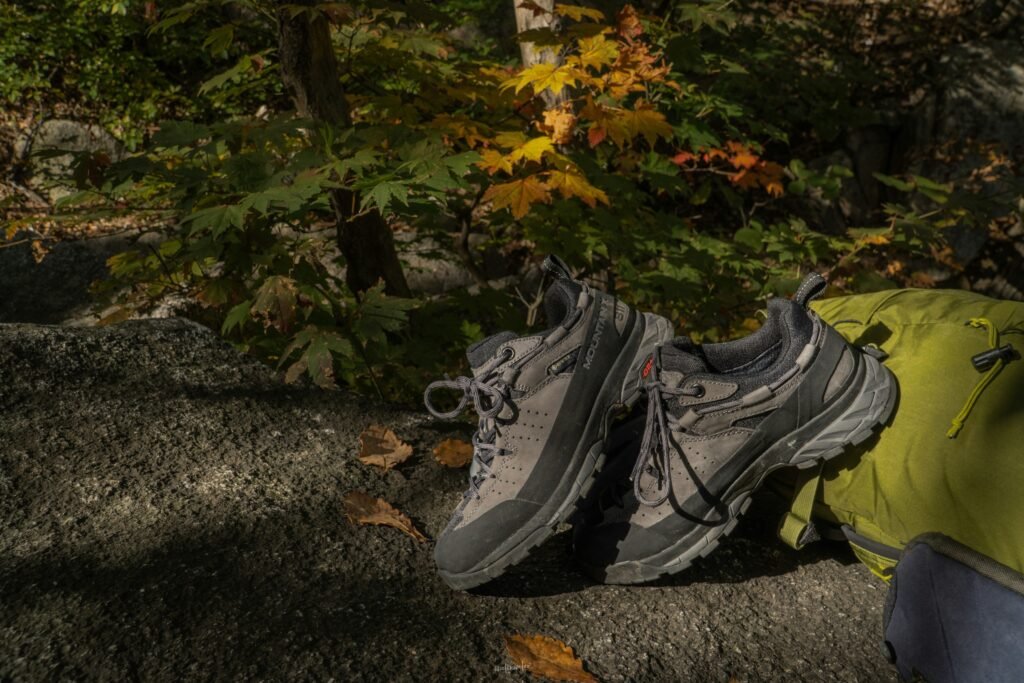
I usually hike in lightweight ankle-high trekking boots with Gore-Tex. It’s a universal
solution that works well for my shorter trips. It’s important that the tread isn’t too deep (so it
doesn’t collect mud), the sole isn’t too soft (which tires your feet), and the size is slightly
larger than your foot. On long hikes, feet swell and perfectly fitted boots can become
painfully tight. If the boot is too big, the foot slides around, causing blisters and discomfort.
A solution is to wear a second pair of socks (not too tight, so circulation isn’t restricted) and
remove them once your feet swell during a long day.
As for breathable membranes — let’s be honest. In wet conditions, all boots eventually get
soaked. Low-cut boots fill with water quickly; higher boots last until the upper gets wet. The
most durable option is probably greased or waxed leather, but it’s very heavy compared to
modern materials. Waterproofing treatments help, but only for a while.
The worst situation is when cold water sloshes inside soaked boots while you’re wading
through snow. Fortunately, this doesn’t happen often. For such cases, disposable chemical
foot warmers are helpful. They’re extremely light and can keep feet warm for up to eight
hours (along with the water inside the boot). If needed, they can also be used in gloves.
Socks
Best with flat seams, made of wool (unlike cotton, wool does not completely lose its
insulating properties when wet), comfortable, and not restricting blood circulation. A wide
selection of trekking socks with reinforced areas can be found in sports stores.
Underwear
According to personal preference, but comfort is more important than looks. It would be silly
to forget it.
Clothing
The “layering” method has long been known and used by hikers. It takes a moment to
squeeze into multiple layers, but it pays off in comfort and versatility. Modern technical
fabrics have made it possible to create a universal clothing set that weighs little and takes up
relatively little space. Sports stores offer a full range of clothing in different thicknesses, cuts,
and purposes. How do you make sense of it all? The U.S. Army created a system called
ECWCS, which organizes what used to be a more intuitive approach to layering.
- Thin polyester base layer (thermal underwear) – full set. Its main function is to
wick moisture away from the skin and prevent chafing. - Slightly thicker thin-fleece underwear – full set. This layer provides insulation but
must also allow sweat to escape. Air trapped between the first and second layers also
insulates. - Fleece with a weight of around 100 g/m², or a looser fleece jacket for extra warmth
when needed. - Windbreaker jacket – very light, thin, breathable, and windproof. Wind can
significantly chill the body. Used in relatively warm but windy conditions with one of
the base layers. - Softshell without a membrane but with water repellence – jacket and pants. The
most versatile layer and a good starting point when building a hiking wardrobe.
Protects against wind and light rain, is comfortable, and highly breathable. - Gore-Tex – jacket and pants. A layer that protects against rain and wind. Thanks to
the membrane, you won’t be completely soaked with sweat during exertion. - Down or PrimaLoft insulation – jacket and pants. Prevents heat loss in extremely
low temperatures or during long stops. Down compresses very well and takes little
space, but it is not moisture-resistant. PrimaLoft was designed to reduce this
drawback, though it doesn’t compress as well as down.
Everyone will adapt this system to the forecasted weather, but for the curious, here is a table
of clothing combinations recommended by the army depending on temperature and activity:
Temperature High activity Rest / break
Above 10°C 1 + 2 (upper body) + 6
0 to 10°C 1 + 4 + 5 (pants) or 1 + 5 1 + 3 + 5
-20 to 0°C 1 + 2 + 5 2 + 5 + 7 (jacket)
-30 to -20°C 1 + 2 + 3 + 5 1 + 2 + 3 + 5 + 7
I sometimes use wool underwear instead of polyester. It provides better insulation even when
damp and reduces odor during multi-day trips, but it’s more demanding to wash. Of course,
many items can be replaced with what you already have in your closet. Just remember that
cotton does not wick moisture, and sweat-soaked clothing on a cold or windy day can quickly
chill the body. Also remember the four basic clothing rules: CLEAN, LOOSE, DRY,
COOL.
Clean clothes insulate better than dirty ones. Loose clothing traps air and keeps you warmer.
Wet clothes conduct heat more easily. If you dress too warmly, you’ll sweat, lose fluids, and
your clothes will become damp and lose their insulating properties.
Hat, Scarf, Gloves
A thin windproof hat, light gloves, and a neck gaiter should always have a place in your
backpack—even in summer. Mountain weather can be unpredictable. Neck gaiters are
especially versatile, inexpensive, and take up very little space.
Membranes – How Clothing “Breathes”
Outdoor clothing manufacturers compete in advertising breathable fabrics. How does it
work? The idea is simple: a thin film is perforated with microscopic holes, laminated with
fabric on one or both sides, and sewn into a jacket. Flowing water doesn’t have enough time
to penetrate the pores, while sweat slowly evaporates outward. The driving force is the
difference in pressure and temperature.
The devil is in the details. If the holes are too large, the jacket isn’t waterproof. If the
adhesive is wrong, sweat has nowhere to escape. If there are too few holes, moisture can’t
keep up. The same happens when someone sweats heavily. If the film isn’t mechanically
durable, it quickly degrades and leaks. If pressure or temperature differences are small (for
example under backpack straps or on hot, humid days), the process is inefficient. If the jacket
isn’t kept clean, the pores can become clogged with salt crystallized from dried sweat. Many
things can go wrong compared to what the manufacturer envisioned in the lab.
My conclusion from using different membranes is that cheap ones are fragile and inefficient.
Expensive ones work better, but miracles shouldn’t be expected. They perform much better in
cold weather, and it’s worth choosing jackets with extra ventilation (such as underarm zips or
mesh chest pockets) to help remove moisture as effectively as possible.
It’s also said that there are membranes that work on a physico-chemical principle (without
pores), binding moisture on the inside and releasing it outside—but the rules of use seem to
be the same.
The art of packing largely comes down to reducing the number, weight, and volume of items
you take while maintaining full functionality. Modern technology, the ability to use items in
multiple ways, and limiting your needs all help.
From the bottom of my heart, I wish you success in this not-so-easy task, a light backpack,
and well-marked trails.
See you on the trail.